Dark Sky Heart
A Theory of Exhaustion: Part V

Previously, we saw how technology and science accelerate horizontal growth, enabling an unimaginable power over nature, society, and “the world” that subjugates the individual and the collective to the unquestioned necessity of its own growth: the growth of “progress” embodied in numbers, calculations—expansions of capital and assets in an economic sense, or “likes,” “views,” and so forth in the social sense. Pythagoras was right: all is number. But not in the way he thought or hoped.
Horizontally, we grow. Vertically, we shrink. We no longer feel or hear deeply, powerfully, passionately. Vision as sight has eclipsed our ability to receive. This is the dominion of ocularcentrism, as historian Martin Jay puts it in Downcast Eyes (1993), or life by sight. It is a sight by light that penetrates, pervades, and blinds. A life by the far and wide.
Did anyone stop to think that we need the darkness, the depths? Where can one see the night sky in its full splendor? One must go to an “International Dark Sky Park” like Joshua Tree to “see” darkness. Light is so invasive that darkness must be federally protected, including the national parks that secure the dark. Without it, entire ecosystems vanish.
As does spirit.
Darkness is an endangered species. Naturally, it was Plato who first criticized his fellow philosophers who met in the quiet depths of night. The darkness was sacred and afforded the qualitative space to think deeply and differently, unobstructed by the light that fills, leaving no space in which to wander.
In contrast to his predecessors, Plato valued the dark hours merely because they afforded leisure time from the day’s activities. He couldn’t comprehend the value of darkness in and for itself that Parmenides, the father of Western philosophy, saw so clearly, who Plato figuratively “killed” with his philosophy to the extent that he was accused of patricide (killing one’s father). From there, darkness declined.

Joshua Tree National Park, Lance Gerber/DESERT Magazine (photo linked)

Joshua Tree Night Sky showing Milky Way, or “Silver River” in Chinese, or “Star River” (National Park Service, photo linked)
Herein lies the radical irony. Many would name the “spirit of darkness” today the “devil,” while not professing belief in him. However, this is not the spirit of darkness at all. It is the spirit of light, the “light-bearer,” who extinguishes darkness.
Lucifer is light. Bearing light, he illuminates. He enlightens. He clears up (German aufklärgung, or enlightenment) our heaviness so that we no longer look to the stars, which we in any case cannot see, in wonder or reverence but only to our screens in shallow comfort. Space is a vacuum, but its emptiness pales in comparison to the vacuity of spirit.
Look to the night sky of Los Angeles or any city, and what do you see? Light. Or, better, “light pollution.” This spirit of Lucifer pollutes the darkness that would otherwise teach us to feel, hear, and live more deeply, more deliberately, as Thoreau would say (Walden 72).
Plato and his lineage believed themselves to be drawing humanity near the heavens with their light. Ironically, in many ways they were an instrument of darkness, which is to say the spirit of light, of intellect: the foreclosure of the dark divine.

Light pollution of Los Angeles, CA, an inverted heaven where the only stars are stars of the earth, which are not nearly as inspiring (Mike Knell, photo linked)
As philosopher of science Michel Serres puts it in a resonant conversation on the lineage of modern science, and physics in particular,
Nothing new under the reign of the same and under the same reign, preserved. Nothing new and nothing to be born, no nature. This is death, eternally. Nature put to death, its birth unwanted. The science of this is nothing. It is calculably nothing. Stable, immutable, redundant. It recopies the same writings, with the same atom-letters. The law is the plague. Reason is the fall. (The Birth of Physics 109)
The spirit of science and technology expands our horizons and closes distances while simultaneously closing off vertical horizons of height and depth. We see and know more but feel and live less. We have plenty of information but little meaning. We have infinite data, but no stories. We’re “connected,” but not with narrative.
Ironically, the spirit of darkness, which is the spirit of light, smothers its own capacity to see clearly, for the light pollution of cities cuts off our ability to gaze at the very stars scientists employ technology to study.
As Serres reminds us, the eye sits at the top of the cone of perception, our head (101). Other senses, like smell and taste, are literally and figuratively below sight. I would add that our mind and brain sit atop our bodies literally and figuratively, as well, so much so that we see ourselves as disembodied minds. This is why the suit covers the body entirely, nullifying and standardizing a man’s body, for instance, as nothing but a vessel for the brain of the achievement society in its relentless technoscientific race.
This reality precedes and exceeds technological society today. It was present when Henry David Thoreau wrote Walden (1854), in part to critique the burgeoning Industrial Revolution, but also the general state of chronic labor and toil that evaporates presence and joy, regardless of technology, whereby most people are seen “creeping down the road of life” (Walden 5). Witnessing the bare meanness of the lives of his fellow citizens in Concord, Massachusetts, Thoreau famously concludes,
But men labor under a mistake. The better part of the man is soon plowed into the soil for compost. By a seeming fate, commonly called necessity, they are employed, as it says in an old book [the Bible], laying up treasures which moth and rust will corrupt and thieves break through and steal. It is a fool’s life, as they will find when they get to the end of it, if not before. . . . Most men, even in this comparatively free country, through mere ignorance and mistake, are so occupied with the factitious cares and superfluously coarse labors of life that its finer fruits cannot be plucked by them. (5)
Whether labor consists of plowing a field or answering endless emails, the result is the same: life unknowingly vanishes in the stream of menial tasks.
AI, they say, will eliminate many such tasks, freeing up time. Of course, this was said of smartphones, email, internet, personal computers, radio, planes, cars, telephones, telegraphs, assembly line, and the like. And here we are, still tirelessly working, and in many places (like Los Angeles) perhaps more than ever.
As technology closes distances in space and time, ostensibly freeing us to enjoy the meaningful things, clearing space, such space is quickly filled by more tasks, a higher workload, more notifications, more expectations, and more communication.

Replica of Henry David Thoreau’s hut at Walden Pond in Concord, MA, today a tourist attraction loaded with people (photo linked)
Whatever spacetime technology opens is filled by means of technology itself, and then some. Email, for instance, made communication considerably faster, saving time in the tasks of handwriting, filling out addresses, buying postage, visiting the post office, and so forth.
But this time freed up by technology was reciprocally filled through technology itself. Since emails were faster than letters, more emails came. Hence, we spend more time than ever communicating. Texting considerably worsened this phenomenon. Then, social media. Now, we are always available, always on call, which is to say unavailable to ourselves, to rest. There are no boundaries, no personal space, no freedom, and, hence, no peace.
Given this situation, we do our best. Our response is often one of escape, or fugitivity. At night, we play fugitive from the technoscientific regime. We “entertain” ourselves. Drive through any suburban area on a cool Southern California night and witness the fugitivity captured in the glare of screens caught through bedroom windows. “Bedroom communities,” they call them. Because where else is there to go? What else is there to do? We turn out the lights and escape vicariously through lives more dramatic than our own, more interesting than the repetitive slog of materialism masquerading as progress, as productivity.
Productive for what? For whom?

Typical suburban bedroom community (photo-linked)
Is it fugitivity or captivity to be glued to a screen in an (un)conscious attempt to feel anything other than extortion of one’s energy, one’s energic potential welled up deep inside where one can hardly feel any longer anything other than exhaustion? Fugitivity or captivity? Is there a difference if the outcome is the same? Is there a third way?
Incidentally but not intentionally, this too often invisible (because it is omnipresent) regime affords entertainment as a means of escape. This escape alleviates pressure, allows one to “wind down” to ensure that one is ready to “wind up” the next day. Relaxation is fatefully enjoined to tension, to a doing and undoing that is endlessly taut toward achievement and productivity.
The stress-producing regime offers stress-reducing “activities” to increase maximum imposable pressure, or else the portfolios could not grow, the profits could not expand, and the companies would not yield, embodied as they are in percentages, these single numbers that signal a semiotic transcendence (Kaczynski 71-72).
What is it to yield? To produce, bear, but most of all surrender. What do we do? We yield to this yield, this kingdom of ratios, of relations as number—all our relations enfolded into a relation that yields to the number as Other, the “big Other” of this symbolic order, as psychoanalyst Jacques Lacan would say (The Seminar of Jacques Lacan, Book III: The Psychoses, 1955-1956, 56). From here, from there, onward to yet another number, another yield, another domain of the reign. Reign of the same.
The calculative empire rises.

To ask if there is an “end” is to violate the non-consensual contractual agreement of the regime that prohibits endings. Every ending is a beginning to still another end, which begins again. Aways beginning, but never becoming.
One no sooner arrives to a number, product, goal, or “achievement” than one begins. Since there is no time to linger or reflect, awareness of the insanity of the never-ending is no problem. Once one’s feet touch the ground, they rise. But the sweetness of the ground, if only momentary, is alluring enough for ascent to dream of descent, to the always already there but inaccessible, to the incalculable beyond (beyond yield).
If there is a top to this regime, a final plot on the line of annual yields, who will reach it? What resides there? If numbers cease to rise, what then? Perhaps time itself, as the pathological as psychological, which is to say psychotic, time of calculation achieves its telos, its end, which is nothing other than an annihilation ironically imposed by its own delusional premise, its insane game of numbers.
In this regime of knowing, the number is a construct that kills. In suicidal ideation, numbers dream. Their dream is our undoing. Their rise is our fall. Each rise is an inverse descent. What happens when a number cannot rise, when it ungraciously falls? Where does it land? Does it realize it never existed at all?
Yet numbers do not end, so in this game there is no terminal surpassing, no achievement outside of achievement, number outside of number, knowing beyond knowing. One is fatefully braided to the game playing itself through us, bodies upon bodies, added up. Human capital, as it were, the capital of the cruelly lowercase.
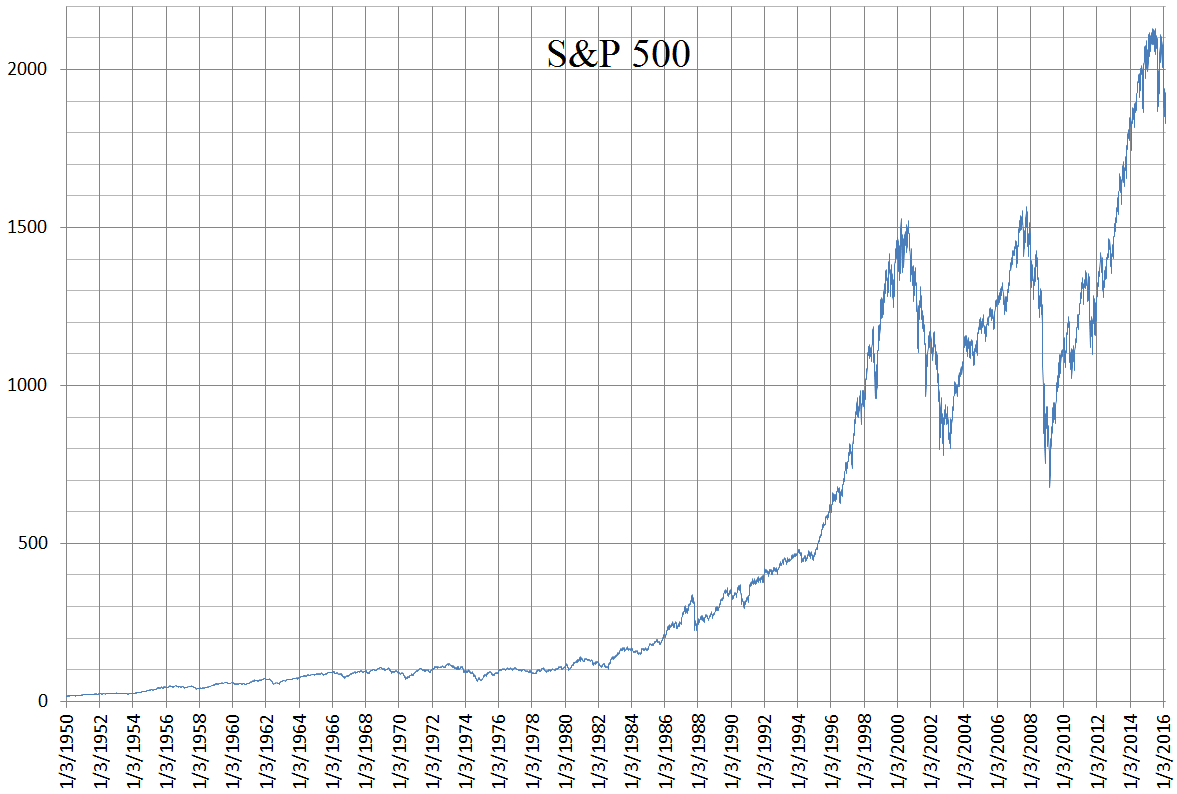
The calculative regime from 1950 to present as illustrated by the top 500 companies
Still, we go on. Enter AI.
AI is supposedly making life more convenient than ever, eliminating many tasks. ChatGPT helps lawyers generate much of the content paralegals did; generate code once manually written by software engineers; draft emails for us; analyze, interpret, and summarize our notes in written or even podcast form; interpret data for doctors, from X-rays, to medical history, and the like, recommending treatment plans. The list goes on.
At first, new technologies appear to be a blessing. Cars are faster than horses. Emails are faster than letters. AI overviews are faster than Wikipedia or firsthand research. AI generative content is faster than thinking, reading, and writing for oneself.
Faster, always faster. Always more. Did anyone stop to think that perhaps there is value to the slow and steady, the ponderous and lingering?
Although one can abstain from technologies at first, choosing not to buy a car or smartphone, for instance, soon society is structured around that technology in such a way as to require it (Kaczynski 56-57).
As Heidegger suggests with his concept of “readiness-to-hand,” our perception of tools and their uses shapes how we interact with and (re)construct the world. In some sense, the hammer shapes the hand as much as the hand shapes the hammer. Before we know it, we have an entire “system” that obliges us to engage an enormous host of technologies that crowd out the slow, the lingering, and the contemplative.

Visualization in an article about how ChatGPT works (photo linked)
In What Is Real? The Unfinished Quest for the Meaning of Quantum Physics (2018), Adam Becker recounts how Nobel Prize winning quantum physicist Wolfgang Pauli once said to a colleague, “I do not mind if you think slowly, but I do object when you publish more quickly than you can think” (48).
Faster is not always better. Often, it is worse. It is the slow, lingering stroll through thought that clears space for new ideas, as was the case for many breakthroughs in relativity and quantum theory. If there is no time to linger, Han notes, there is not only no space for peace and rest, but also no space for creation: “Whoever is not capable of stopping and pausing has no access to what is altogether different” (The Scent of Time 104).
Han quotes Heidegger on our “never dwelling anywhere” as a result of the acceleration of life (62). For, “essential existence” is “slow” (63). Without slowness, dwelling evaporates. Without the slowness of being, creation is null. Hence, the modernist poet Ezra Pound’s dictum to “make it new” becomes void. All we have, as Serres writes above, is “the reign of the same.” Certainly, new technologies emerge, but all with the same purpose and effect: to hasten the age of haste.

“Sharp-tongued” quantum physicist Wolfgang Pauli (CERN/Wikimedia Commons/Big Think/Ben Gibson, photo linked)
Slowness and difference aside, the question is what will we make of the space and time allegedly opened up by AI? What will we do?
While we need not be technological determinists, an unthinking response to AI suggests that these spaces will quickly be filled by means of technology itself. Prepare for even higher workloads, more tasks, more communication, and more information. What is cleared by the fast and excessive is just as quickly filled by it.
Let there be no illusion that the spirt of light that illuminates time and space, hastening knowledge, activity, and pace won’t quickly exhaust that space. It is strictly illogical to believe that such spaces and times opened up by the spirit of haste will be filled by anything other than the fruits of that same spirit. That is the purpose of these technologies, after all: not to give us more time as such, but more time for more work. This is the end game of the achievement society: more, not less. It cares not about your time, only your ability to efficiently complete additional tasks.
How is AI anything other than an extension of this same spirit of light, of haste, of the consummate closure of spacetime itself into the radical exhaustion of modernity?
And yet we still go on believing, don’t we, that one day, with the right technologies, the right apps, the right software, time will once again be ours. Do not be fooled. No such time is coming. More technology will arrive, of course, but it will not free you. Quite the opposite. What at first appears redemptive is nothing less than a tighter grip on your time, your space, your life. For you, achievement society bestows technology. In return, it takes your silence, peace, rest, and freedom.
In The Burnout Society (2010), Han discusses our auto-exploitation at length, the ways in which we become our own masters and slaves in an achievement society of our own making. In search of peace, rest, and security, we work. We need no master to enslave us. We enslave ourselves to endless work. Peace never arrives. It never arrives because we create no space for it, as Nguyen observes (64-67). For peace is not pursued but allowed through empty space, through not thinking, not trying.
Yet technology is not a space of the negative but the positive: full and not empty to maximize consumption. It is a porous and not protected space: open without boundaries to expand the flow of capital and production. It is an alienated and not friendly space: isolated and not communal because the communal encourages peace, rest, and lingering (which is to say “loitering” in the technoscientific regime).
In this way, the tragically ironic cliché emerges: we are simultaneously more connected and isolated than ever. Immanently present in digital space, our algorithmic bodies are without borders, constantly in contact, breaking at the seams. As embodied humans, however, we are without touch, touchless—the skin on skin of mother and child replaced by meshing algorithms cybernetically drawn across the smooth encoded plane of alien(ated) networks embodied only in the circuitry of the never-having-been.
To this effect, the U.S. Surgeon General warns of an “epidemic of loneliness and isolation,” citing “social media” 27 times as a key contributor in the major 2023 report. The effects of loneliness and isolation cascade across mental and physical health, since there is no such separation, only a spiritmindbody that is the entangled culmination of our entire way of life.

Many associate such a condition with newer, more invasive technologies like smartphones and social media. Surely, we think, it was different before the world followed us around in our pockets, before our third-dimensional world was replaced with two-dimensional surfaces.
This, however, is not the case. It is not only newer technologies that occupy a prominent role in our subjugation to work, to activity. While Han pinpoints the distinction between the transatlantic slave trade and contemporary auto-exploitation, where each individual serves as master and slave in one, Thoreau observed the same phenomenon circa 1846. At this time, the sewing machine was state of the art, as well as commercial telegraph lines. Telephones didn’t arrive until 1876. Naturally, there was no internet or television, not even radio. Slavery had not yet ended, although the north was ostensibly “free.” Nevertheless, Thoreau writes in Walden (1854),
[T]here are so many keen and subtle masters that enslave both north and south. It is hard to have a southern overseer; it is worse to have a norther one; but worst of all when you are the slave-driver of yourself. (6)
Thoreau illustrates that it’s not the type of technology but rather our relationship to technology that kills us, that lays waste to our time, our lives. Our relation to technology is a reflection of our relation to ourselves. Occupied with endless work, we employ technology in such an occupation.
As we have discussed through Heidegger, technology is an extension of ourselves. A smartphone is no different than a hammer in this regard. We build it because we see use in it. The purpose is the cause, not the human agent. This use extends work, reshaping us as we reshape “it” (the hammer, phone, computer, and so forth).
Once built, the hammer, like the smartphone, helps define the possibilities of work. We design further tools that will work well with a hammer, as with apps for a smartphone. Round and round we go. It is thus not technology that is in charge. It is not technology that enslaves us. Neither the hammer, telegraph, nor smartphone makes any difference to the essential spirit. It is the spirit that creates. In turn, it shapes a relation to the world, inclusive of technology.
The truth is in the assemblage, as Deleuze and Guattari call it in A Thousand Plateaus: Capitalism and Schizophrenia (1980), which political theorist Jane Bennett has done extensive work on (Vibrant Matter 2010). That is, the truth is in the entanglement of human and non-human agencies endlessly shaping each other without a chief agent.
AI is simply another tool. The spirit remains the same, the spirit of the same, of light, reason, logic, calculation, all of which becomes bound to work, production, activity, and the market.
Article introducing Google’s AI Notebook LM, a personalized podcast generator (2024)
Work is not enslavement as such, but incessant activity and production in and for itself is antithetical to peace. As we have noted, our language reflects this economic spirit of enlightenment. Time is spent, saved, wasted, even killed. As Thoreau notes, “as if you could kill time without injuring eternity” (7).
So the spirit sheds the light which illuminates the whole world as “producible in the process of production” (Heidegger, Poetry 114). What undergirds this spirit is thus not particular types of technology but the industrial spirit itself, which is to say not “industry” as such but its etymological roots: to build or spread.
Technology itself is chained to industry. Technology is not an abstract overlord binding us to endless productivity. Rather, technology is permitted to build and spread only when perceived as “productive” by the spirit of light that pervades consciousness, captivates intellect, and excites the ambitious ego.
Returning to Oppenheimer, atomic energy above all illustrates the aforementioned dynamic, where both human being and technology itself are in service to a subtler, more pervasive spirit.
Becker notes how physics funding in university departments, for instance, exploded after the realization that atomic theory could be put to use in weapons development. In the post-war moment, however, once such developments and weaponry were less relevant, “the American Institute of Physics job placement service had 1,053 applicants for a grand total of fifty-three jobs” (210). No longer as relevant, physicists lost funding and employment.
Moreover, the top technology needed for breakthroughs was only accessible at those locations where weaponry was the aim. In The Technological Society (1964), philosopher Jacques Ellul notes that it was only a place like Los Alamos, Oppenheimer’s atomic bomb facility, that afforded physicists the desired instruments. He quotes one atomic scientist who says, “What keeps me here is the possibility of using for my work a special microscope which exists nowhere else” (10).
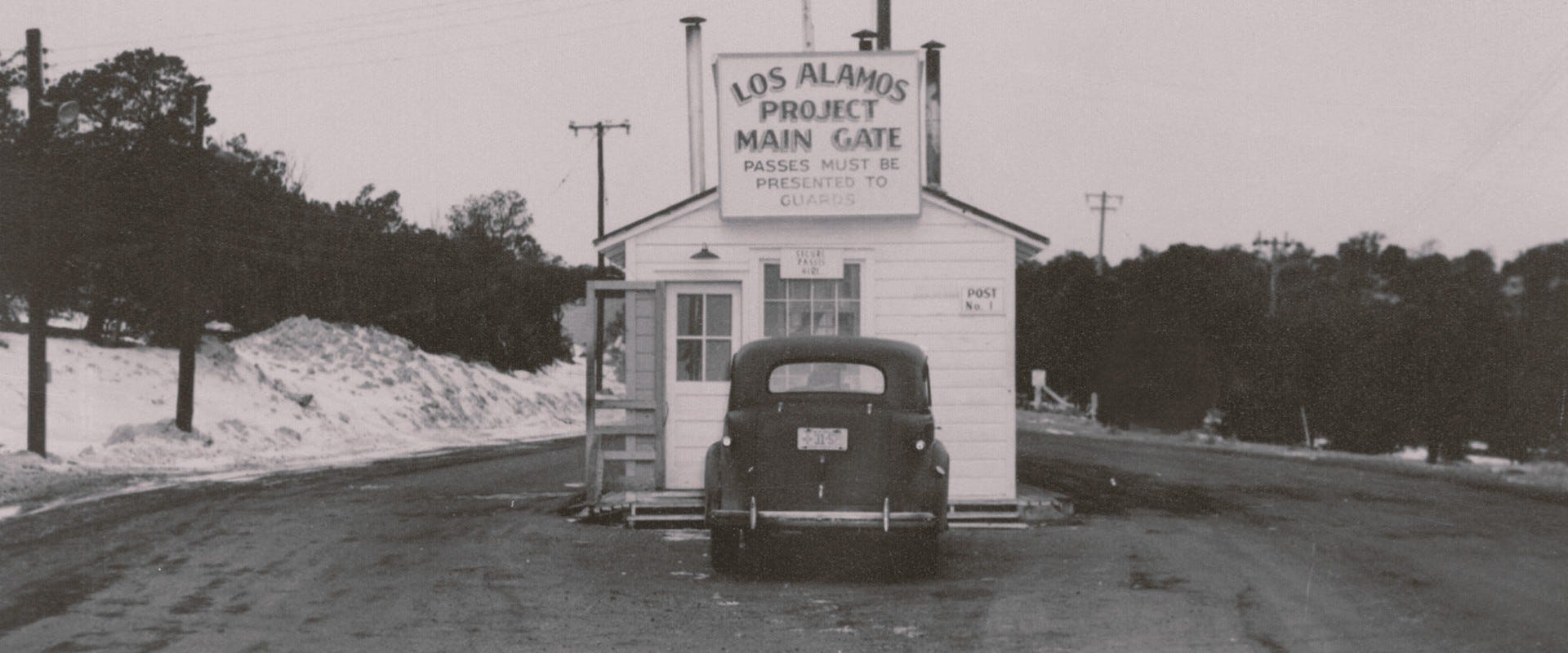
Los Alamos National Laboratory, 1943 (US Department of Energy, photo linked)
Therefore, it is not particular technologies that enslave us. Neither is it technology itself. It is a certain spirit behind technology, a certain value structure inherent in our relation to technology that binds us to production, to activity.
As long as this spirit lives and dominates our relation to technology, no technology, however convenient or efficient, will free our time and our lives from the endless activity that drives the production of such technologies themselves, and which fills any space or time opened by such technologies with further demands to quench that same spirit’s insatiable thirst for further production and achievement, a cycle within which many of us function as indentured servants struggling to find our way out from a system within which no way out has been given.
There is, however, a way out, an aufklärgung, or enlightenment, when there is a conducive turn to the altogether different. Therefore, Heidegger concludes,
Perhaps the world’s night is now approaching its midnight. Perhaps the world’s time is now becoming the completely destitute time. But also perhaps not, not yet, not even yet, despite the immeasurable need, despite all suffering, despite nameless sorrow, despite the growing and spreading peacelessness, despite the mounting confusion. Long is the time because even terror, taken by itself as a ground for turning, is powerless as long as there is no turn with mortal men. But there is a turn with mortals when these find the way to their own nature. (93)
This “turn in mortal men,” when humans find their way to their own nature over and against a relation to technology as evermore efficient and faster production, affords the “ground for turning,” for change: for every turning is a break from the reign of the same, the reign of the spirit of light toward the glittering dominion of the dark, to the spirit of “dark sky parks,” away from the flat two-dimensional screen toward the geometry of the curve, the non-Euclidean domain, the fractured refrain, broken mid-verse, not amenable to change, destroyed from underneath by an abyssal deep rising.
For, as mighty as the spirit of light is and will be, the spirit of the depths lies waiting, an iceberg for every Titanic. Reportedly spoken at the Titanic’s launch were the words, “Not even God himself could sink this ship.” Deuteronomy 6:16 and Matthew 4:7 read, “Do not tempt the Lord your God.”

Titanic (Bettman/CORBIS, photo-linked)

Scientists mapped the entirety of the shipwreck site, from the Titanic’s separated bow and stern sections to its vast debris field (Atlantic/Magellan, photo-linked)
Surely, the spirit of light is a marvelous force beyond apprehension. Lucifer, light-bringing, light-bearer, has penetrated the furthest regions of not only the Earth but also the observable universe, his light pollution obscuring the inner light of souls dimmed by the unbearable noise of technological light and sound.
Yet a different spirit waits, an inversion of the same, a spirit to be called upon but not tempted or named, a spirit hidden but awaiting invitation: this is the power of the call, the summoning, the conjuring, the unadorned incantation.
Regarding the 1941 attack on Pearl Harbor, Japanese Admiral Isoroku Yamamoto famously said, “I fear all we have done is to awaken a sleeping giant and fill him with a terrible resolve,” a resolve that ended with the atomic bombs via Oppenheimer’s project dropped on Hiroshima and Nagasaki in 1945.

Colorized photo of Pearl Harbor attack, 1941 (photo-linked)

Aftermath of Hiroshima atomic bomb, 1945, in part a response to the Japanese attack on Pearl Harbor (photo-linked)
Many fear that behind the enthralling humanitarian uses of AI lies a radical reconstitution of our relation to each other and to technology that is less a reconstitution than an exaltation of the spirit of light such that its permeation of life will be nothing less than totalizing. Through each body and individual, an emanation of the light of technology, fissures in every last border, a voice through every silence.
Will this latest instantiation of the spirit of light be what calls mortals to their own nature, perhaps to the pre-Socratic, Parmenidean sphere of the whole, to the Anchoritic desert of the dark soul nourished by the presence of absence and the sound of silence, to the Daoist’s empty mind and empty dark, on the verge of vanishing?
How is this turn to be induced? What is the necessary incantation for the spirit of the depths to rise up? Perhaps it is the breakdown of the technoscientific regime at the hands of its own exhaustive and exhausting making. For, borrowing from Deleuze and Guattari’s Anti-Oedipus (1972), a break-down is also a break-through (362).
To be continued…